October 2023. I was on a flight, looking out the window as the Netherlands came into view from above. Impossibly neat squares of green, silver waterways cutting through flat land, a country that looked like it had been drawn by someone who actually planned ahead. I hadn't done any research. I didn't know what to expect from Dutch work culture, Dutch people, or Dutch winters. What I did know was that I had spent years in a system where seventy-five hour weeks were normal, where unhappy people in positions of power passed that unhappiness down like inheritance, and where saying no was a career risk. I had enough of it. The ticket was one-way. That was the whole plan.
The moment the plane doors opened and I stepped out into the airport, I got hit by something I wasn't expecting: air. Actual crispy, clean, lung-filling air. I had a moment standing on that tarmac, a tropical boy completely underdressed for October in northern Europe, thinking: okay. Something is already different here.
Eduard, and the First Month
I came alone. I didn't know anyone in the Netherlands when I landed. I was staying in an Airbnb, and the host was a man from Suriname named Eduard. He became something close to an elder brother within the first week. A fellow Sanatani, full of warmth and quiet wisdom, who distributed Bhagavad Gitas and didn't ask for anything in return. When I didn't know where to buy groceries, how to read the bus schedule, or what to do on a Sunday in a country where everything closes, Eduard had an answer. Not a dramatic rescue. Just steady, unhurried guidance. The kind you don't forget.
There were lonely moments. Times I genuinely didn't know what I was doing or where anything was. But there was also something I hadn't felt in years: freedom. No aunties commenting on your life choices. No relatives turning up unannounced to ask why you haven't been promoted yet, or why you're still renting, or when you're getting married. Just open evenings, a new city, and all the time in the world to figure it out.
About a month in, I found a spot to watch the sunset. I sat there for a long time. I didn't feel like I had to be anywhere else. That was the moment I knew I was really here.
The Orientation, the Cold, and the Dutchies in Boxers
The firm's onboarding took place near the coast. October, so already deep into autumn. The hotel was nice, the sessions were structured, and every international hire was doing what internationals do in cold weather: wearing every layer they owned, cupping warm drinks, walking fast between buildings. And then I saw them: Dutch colleagues, outside, in boxers. Just standing there in the wind like it was a mild Tuesday in June. Not performing toughness. Just genuinely unbothered. It's not actually the cold that gets to you, by the way. It's the wind. The kind that cuts straight through to the bone.
That image stuck. The Dutch are not trying to impress you. They're not performing anything. They are exactly who they are, and they assume you'll be the same. After years in a culture where professional image management was practically a sport, that was a revelation.
9:05 AM and the Meeting That Changed How I Think About Management
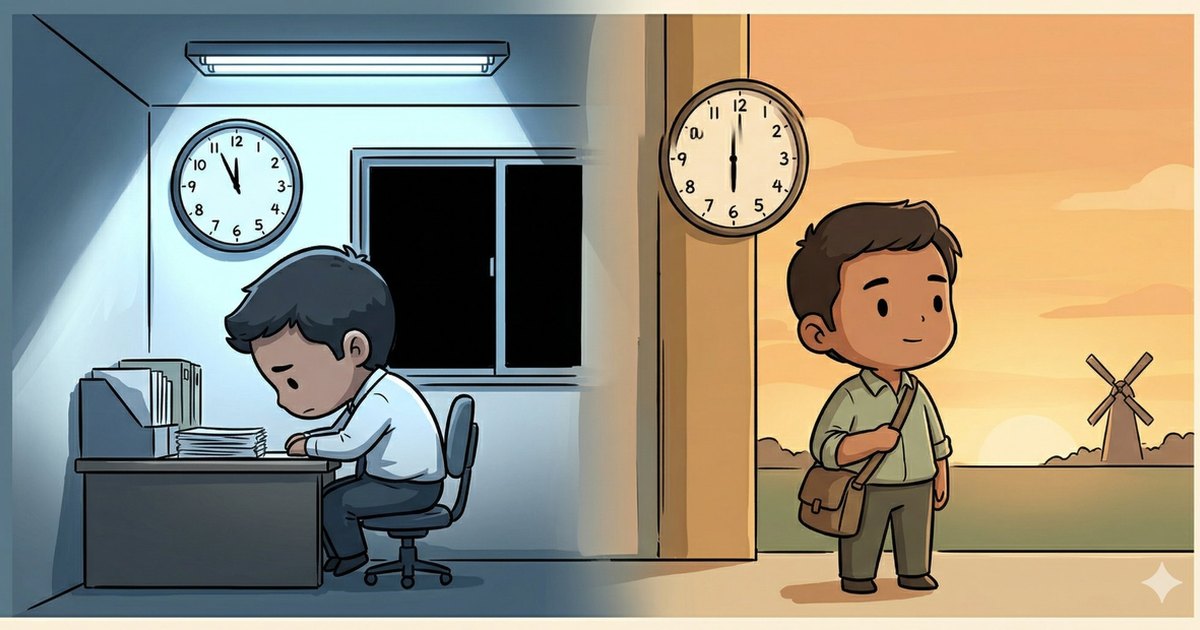
A few weeks in, I was showing up to the 9am stand-up at 9:05 a few times too many. My manager asked if we could step into a meeting room. I prepared, instinctively, for a dressing down. In India, this conversation had a familiar shape: silence, disappointment, a mention of how it reflected on the team, maybe a note in your file. You left feeling smaller.
Instead, he asked me if there was something going on. Did I have a morning prayer or ritual that needed accommodating? Was there a family situation back home? Was the commute causing problems? He went through these with genuine curiosity, not as a trap. I told him about the public transport: cancellations, delayed connections, the unpredictability of getting a tram that actually showed up on time. He nodded, then gave me a practical breakdown of how the public transport actually works, how to read the patterns, how to stay ahead of delays. Then he said something I still think about: "You can't control the cancellations. But you can definitely control leaving fifteen minutes earlier." He mapped out exactly what that looked like to arrive by 8:45, why the buffer mattered for the team, and what kind of precedent it set for the junior I was responsible for.
No judgment. No career threat. Here's the problem, here's the fix. That conversation didn't just make me punctual at work. It changed how I operate everywhere. I'm early to things now. A habit installed by one manager asking the right question instead of reaching for a reprimand.1
Instead of making me feel like shit, they taught me. They showed me. They made sure I acclimated. That's what a system built on respect actually looks like.
Learning to Say No (And What Happened When I Did)
In the environments I worked in back home, you become a yes-man fast. Saying no when your plate is full isn't just frowned upon; it can end things. Careers are shaped by your willingness to absorb whatever is handed to you. You internalise it. You stop asking whether it's sustainable. It just becomes the definition of work.
Here, I was sat down and told the opposite. "Pratik, you need to say no when you have too much on your plate. If you burn out and suddenly you're not there tomorrow, that puts unnecessary pressure on the whole team." I had to hear that a few times before it registered. The first time I actually pushed back on a new task, told my manager I was at capacity, I braced myself. The response was: "Okay. When will you have bandwidth?" That was it. No disappointment. Just a logistics question.
I also learnt the harder way about saying something when things slip. I missed a deadline and didn't flag it early enough. Another calm sit-down: we get that things run over, that's fine, but going quiet about it isn't. Let us know early so we can adjust. It wasn't a reprimand. Just someone explaining how a system that actually works needs people to talk.2

6PM and the Question I Didn't Know How to Answer
The first day I came home at 6pm, I stood in the middle of my apartment and genuinely did not know what to do. In India, I was back at 2am, if I was lucky. The concept of an evening, a real one, that belonged to me, was so unfamiliar that it felt like a mistake at first. Like I'd left early and someone would notice.
I figured it out slowly. The gym became consistent, not because I got more disciplined, but because there was finally time and energy left over at the end of the day. I went from XXL to M. I actually learned to cook instead of just eating whatever was fast. I started spending real time with people, because people here also have time, and it turns out that changes the quality of the conversation entirely.
The Dutch colleagues helped with this too. There's a culture of small, genuine consideration. If someone is getting coffee, they ask if you want one, they take your cup, they bring it back. Nothing expected in return. It sounds minor. What it actually does is build team chemistry quietly over time. You start mirroring it. You become a little more present, a little more empathetic, a little more human at work.
The Honest Part: It's Not All Perfect
The Netherlands has pulled in a lot of internationals over the last decade. Some of them, especially at managerial levels, bring their home culture's habits with them. Micromanagement, overtime as a measure of commitment, blame games, politics. When that happens without any real push to adapt, you get a split: some people experience the Dutch work environment as advertised, others get a transplanted version of exactly what they left.
I find it hard to operate well under that style of management. I think Dutch institutions, which have built something genuinely good here, could do more to protect it. Not through more policies, but by actually expecting managers to operate differently, wherever they're from.3
What I Actually Want to Say
This isn't a piece about the Netherlands being perfect or India being broken. It's about what happens when you land somewhere that treats employees like adults, and how disorienting that is when you've never encountered it before.
Speaking up got me retaliated against in India. Here, it's encouraged. There are internal boards, open-door policies, structures built to actually receive concerns rather than bury them. I had to relearn how to use my voice professionally. That relearning took time. It still surprises me sometimes that it's safe to do it.
If you're reading this on a 75-hour week and wondering whether something different exists, it does. And if you're somewhere better already, I hope you don't take it for granted. What one person in one meeting decides to do, ask a question instead of passing judgment, say something instead of letting it pass, it adds up. Over years, it makes a culture.
We work to live. We don't have to let work consume us so much that we forget why we started working in the first place. We were meant to be free. Work is how we fund that freedom, not how we surrender it.
I didn't come to the Netherlands with a plan. I came with a breaking point and a window seat. The crispy air hit me first. Everything else followed slowly, through Eduard's quiet wisdom, through a manager who asked the right questions, through 6pm evenings I had to learn to fill.
It gave me my life back. That's really all I have to say.
Sources
- Wikipedia — Power Distance · India scores 77 on the Power Distance Index; Netherlands scores 38. The gap is one of the widest between any two comparable economies · en.wikipedia.org ↩
- OECD — Average annual hours actually worked per worker · Netherlands consistently among lowest in OECD; India among highest · stats.oecd.org ↩
- World Happiness Report — World Happiness Report 2024 · Netherlands ranked 6th globally; India ranked 126th · worldhappiness.report ↩
If you are weighing up the same move, or you have already made it, I would like to hear how it went. Find me on LinkedIn.